More information will follow shortly, but the format will likely be very similar to past years:
Getting started around 6:00 PM on Friday, announcing the theme, brainstorming ideas, and forming teams, etc…
Full day of work on Saturday
Finishing up on Sunday by 3:00 PM, showing off the games to each other afterwards.
This is the 4th year of the Global Game Jam; to get a better idea of some of the cool things possible in a weekend, check out some of the games made in the triangle area in past years:
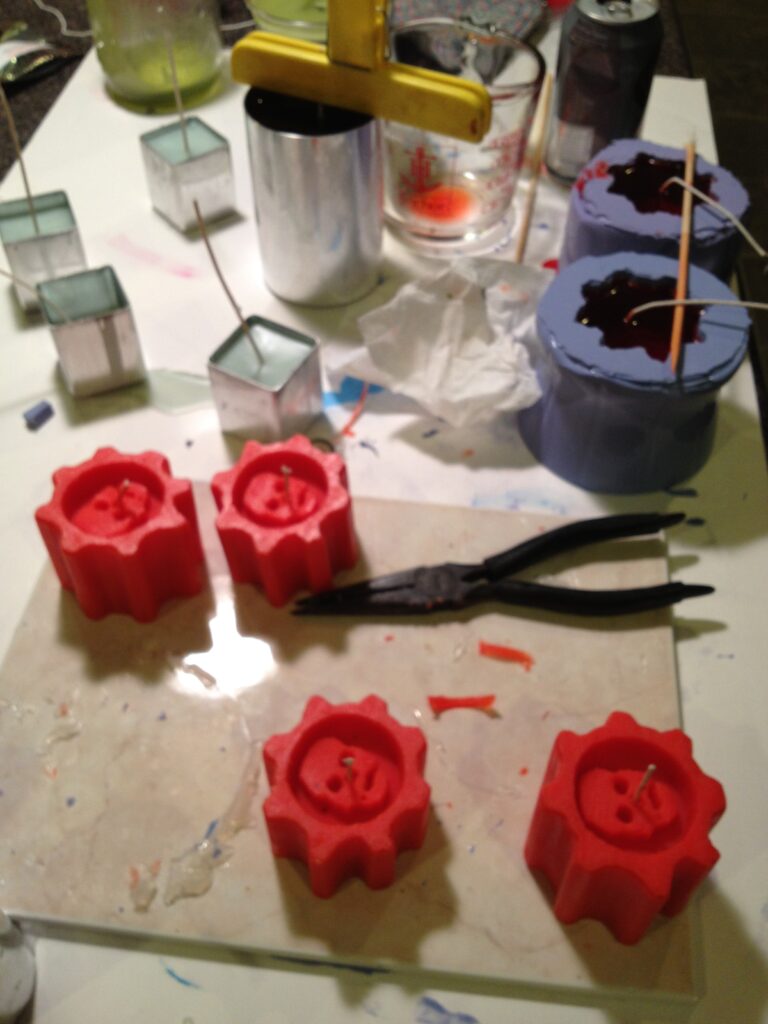
One of the things I made for Christmas gifts this year were candles. In addition to the typical cylinder and square candles, I made some candles in the form of the Gears omen and a lime.
Making candles with a homemade mold
For my first time making molds, and first time pouring candles, I’m really happy with how things came out.
I cast the first few batches using votive wax, which only takes one pour and gives a creamy consistency, but they lose their shape pretty fast when lit. After that, I switched to a pillar wax, which has a little more surface mottling and needs 2+ pours, but keeps it’s structure much better. Most of the candle supplies came from a site called CandleScience, which is actually in the area, so I can order online and pick up the order the next day without having to pay shipping.
I’d done a bit of reading about mold making in the past, but there was a class on molds and resin casting at The Gamer’s Armory that convinced me to order some supplies from Smooth-On. I used OOMOO 30 for both molds. The lime mold was made using a real lime skewered with a wooden stick, while the omen candles were made from a wooden positive modeled in VCarve Pro and cut on my CNC. It was made of 3 layers of 0.75 in plywood glued together and sprayed with some clearcoat. I cast two molds using sections of 2L soda bottles hot glued* to a floor tile.
Mold positives made on CNCPositives before sanding and gluingMold positives glued into placeThe perils of hot glue and PETFinished moldsHot waxMaking candles with a homemade mold
*A word to the wise: High-temp hot glue is hot enough to melt PET soda bottles! One of the two molds wasn’t sealed properly as a result and I had a decent sized leak of the purple ooze, but thankfully I had everything centered on a large piece of foamcore, so it didn’t ruin my countertop. Next time I’ll probably use clay as a seal.
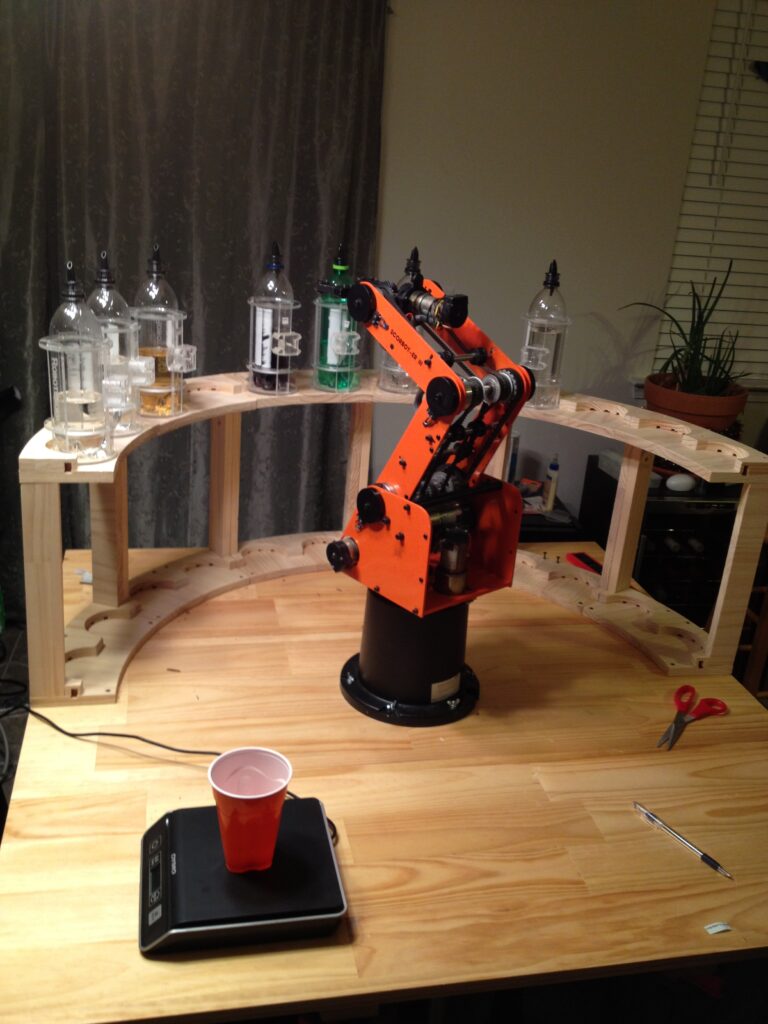
Finished Robotender Mk3 just in time for my halloween party (with literally minutes to spare). This one is a pretty radical departure from the previous designs, using a robotic arm instead of pressurized dispensing. I managed to pick up a Scorbot ER-III arm and controller off of eBay. They were originally used for teaching robotics and motion planning at universities, and are generally pretty used-and-abused (two motors were almost falling out of their mounts on this one), but it runs quite nicely after everything was cleaned and tightened up.
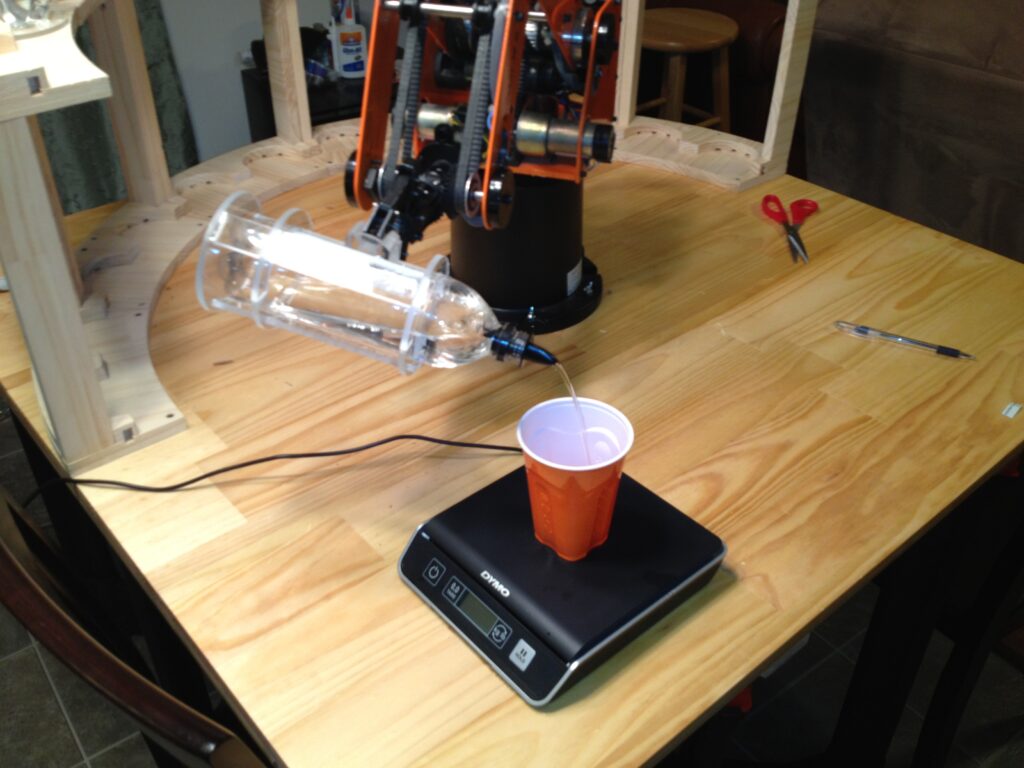
It’s a little slow compared to the Mk1, but it’s a lot of fun to watch, can hold more bottles, and is easier to maintain. It uses custom bottle carriers that hold 710 mL soda bottles, and can hold up to 24 such bottles. There is a digital scale hooked up to the computer as well, which gets zeroed once a bottle reaches the pour site, letting it determine how much liquid has been poured much more accurately than the simple time-based approach used in Mk1.
Pouring an ingredient
I took a number of pictures during construction on this one, so I may do a build log post later.
Next steps:
I’m going to look into building a new motor controller for it, so I can get better feedback and drive it faster while still keeping a solid grip on bottles (can’t currently ignore the gripper stall state for fear of missing any other motor stalls, meaning I have to do a slow 1/10th speed backout on the gripper to get the max grab force I can).
The bottle holders are on their 6th iteration already, but positive grip is still a bit of a problem, so I’m probably going to redesign the bottle holders with a triangular slot and make some triangular nylon plates for the gripper. This might also allow me to be a little less precise in the back-off, and speed it up without a new motor controller.
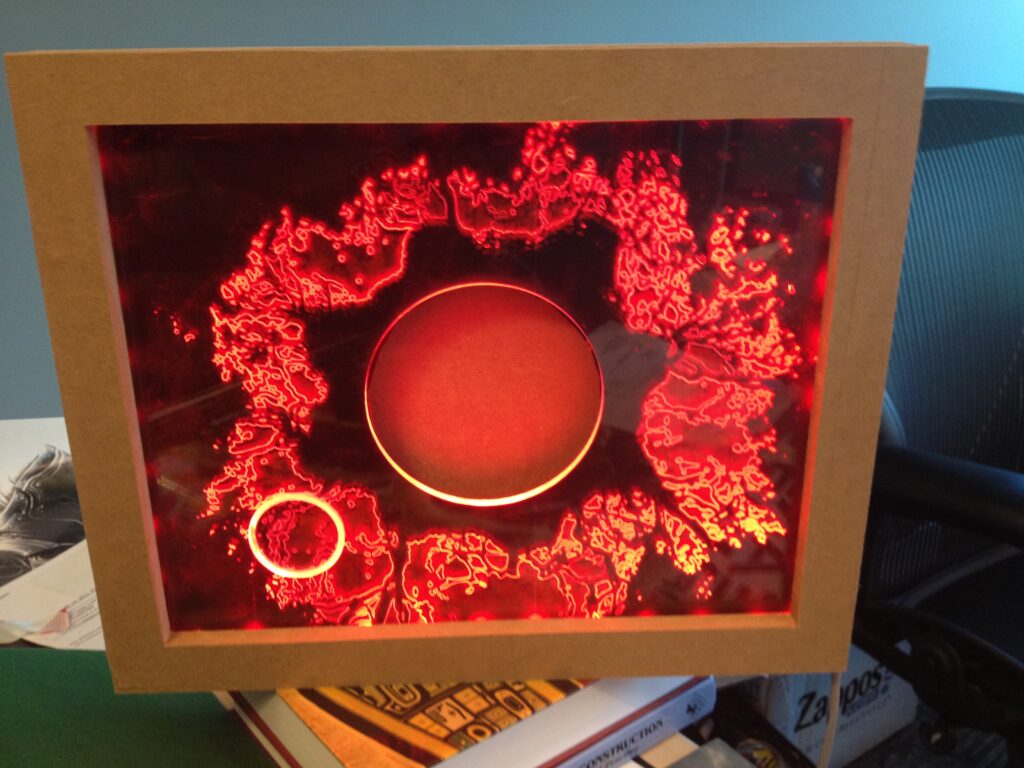
I pulled an all-nighter and designed/fabricated a LED edge lighting box plus etched plate in advance of the Gears 3 launch. The original plan was to slide an unused junk android tablet in and show some numbers from the stats dashboard in that central window, but I wasn’t able to get the tablet on the secure network at work, so now it’s just a pretty light box sitting on my desk. I almost slid my iPad in, but the slot I machined for the tablet is about 0.5 in too short for an iPad, though it had 0.75 in of slack for the target tablet.
The light gently pulsates / undulates around the border (driven by an Arduino), aiming to look a bit like the corrupted omen on the title screen.
The LED strip I used are LPD8806 driven strips from Adafruit, and they are a dream to use compared to the older Christmas light strand style strips I’ve used in the past. Each LED is individually addressable via a SPI-like interface to set a 21 bpp RGB color, and they have their own internal PWM clock, so you can fire and forget, no need to keep clocking them.
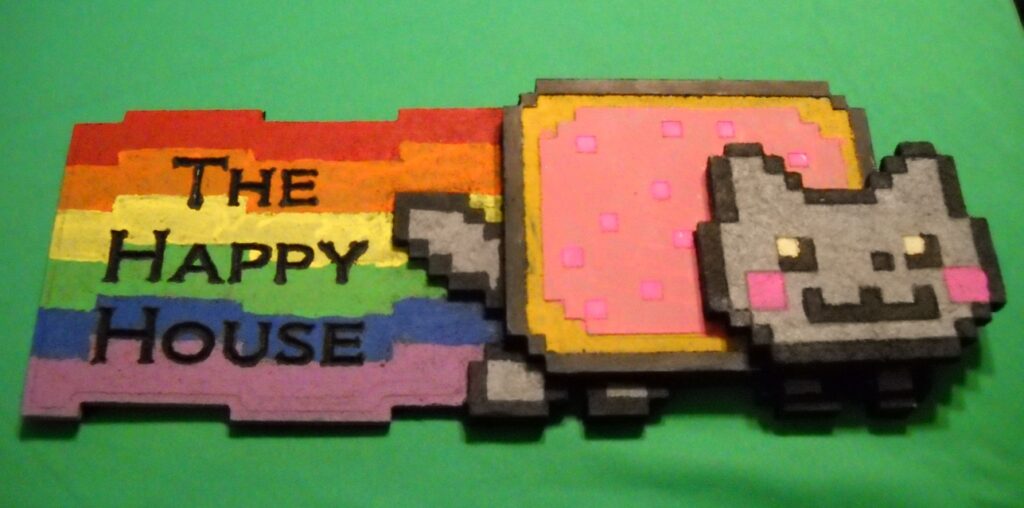
A friend of mine recently got a house in Raleigh and dubbed it “The Happy House”. As a housewarming gift and as a test of my new CNC, I wanted to carve a plaque for the place.
I tried to think of something that brings irrational happiness to people and settled on Nyan Cat. It took a little bit of design work, resulting in a nice and fast CNC run, but painting it took longer than I expected. Even so, it turned out quite nice and everyone at the happy house loved it.
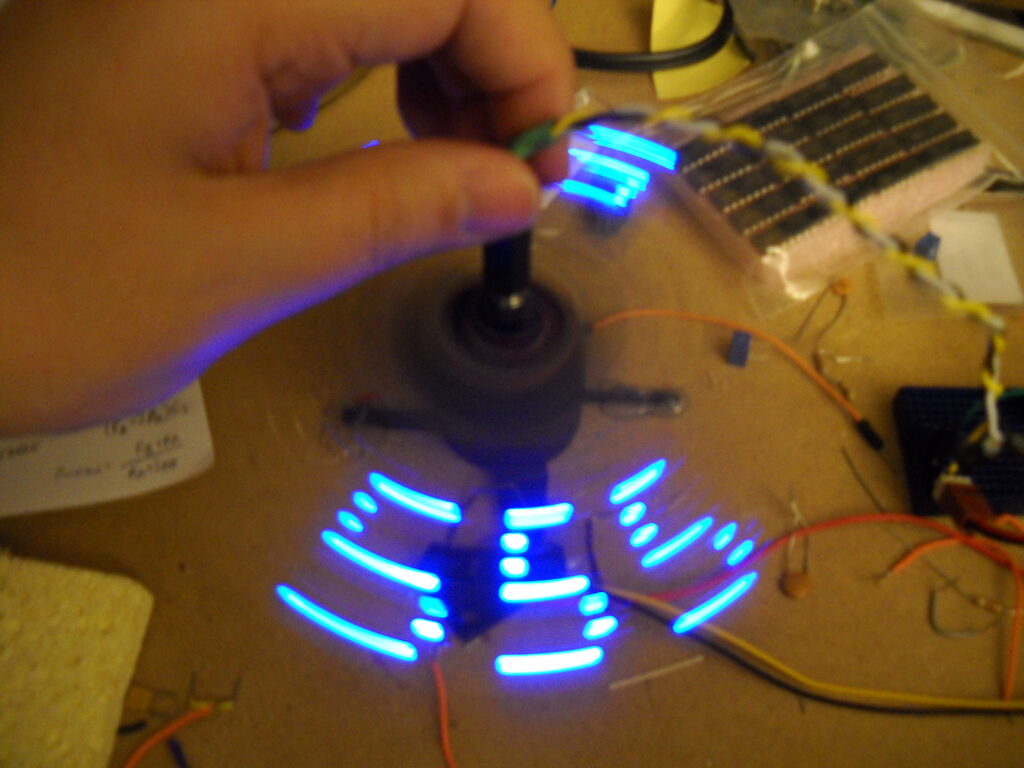
I took 3rd place in the minimalist category of the 555 timer compo for my persistence of vision display. I’d also like to thank Allerta and CafeLogic for sponsoring the compo and the cool prizes (an iPulse watch and a box o displays).
I gave a talk at the East Coast Game Conference this year titled “Guided Content Optimization for Gears of War 3”, which went over pretty well. The slides are available here.
The talk was about the processes and tools that we developed/extended to help make Gears of War 3, covering our philosophy, memory and performance feedback loops, and some of the tools that help gather, process, or visualize performance data.
The talk was intended for a more general audience, but there are lots of UE3 specific documents on UDN that dive into more detail: