Glitchovision 3000

This is an audiovisual instrument that I created for the 555 timer contest.

The Glitchovision 3000 is a 4 step sequencer controlling an ‘Atari Punk‘ synth with a greyscale NTSC video visualization of the output audio, built using two 558 quad-timers and two 556 dual-timers.

Here is a video of it in action:

Theory of operation

  • Video timing (two parallel channels of 1/2 556 feeding into 2/4 558, and finally combined via some 74ls08 AND gates).
  • Audio generation (4 step sequencer built from a 558 feeding into a 556 setup as a stepped tone generator).

Video timing (556 feeding into a 558)

First, a 556 (configured as two astable timers) generates two independent blanking signals, one horizontal and one vertical.

These signals are low for the time specified in the RS170 standard (3 lines for vsync, 10.9 us for hsync), although the final result isn’t exactly up to RS170 spec. It generates a ‘combined’ or industrial sync (which works on every TV I’ve ever tested), but RS170 requires serrating and equalizing pulses to be generated during vsync to prevent 1950s hsync oscillators from losing tracking.

Each blanking signal is fed into a 558 monostable timer, which generates the blanking signal (lasting longer than the sync signal and delaying until the image is about past the overscan).

The output of the h or v blank is fed into a second pair of 558 timers to generate an ‘active’ region of the screen, where we can display arbitrary data.

The two sync signals are combined with one AND gate into a CSYNC signal and the two active signals are combined (with wired AND from the 558 open-collector outputs, but buffered into another AND gate) to generate a CACTIVE signal.

These signals are used to generate the final composite video output, when combined with the audio signal.

Audio (558 feeding into a 556)

One 558 quad timer serves as a 4 step sequencer, similar to a traditional use of a 4017 decade counter. All four steps use the same timing components, but the overall step rate is controlled by varying the control voltage for the 558 timer. You can chain several 558’s together to get longer sequence lengths, but I only ended up wiring switches and pots for 4 steps.

The output of the sequencer is combined with the ‘left’ potentiometer of an atari punk synth implemented in the other 556 (conflating the two for the timing of the astable portion of the synth). The monostable portion of the Atari punk is bog standard, triggered by the astable portion.

The audio output is line conditioned and output, as well as being ANDed with the CACTIVE signal and merged with CACTIVE via some mixing pots to generate a final video signal. Listen and see that atonal goodness.

Notes:

  • Note 1: Adding a reset switch instead of relying on power-sequencing during startup seems like a solid addition. I didn’t have it in the prototype shown in the video, so it’s listed in the schematic in a dashed box. It would also provide a nice ‘tap to the rhythm’ reset, although it wouldn’t stop the later stages from playing like a reset on a 4017 would.
  • Note 2,3: Adding a pair of diodes here to keep the range of CV to ~0.7 to 4.3 V, or even some fixed value resistors should help prevent nastyness when the control voltage is taken too far out of whack.
  • Note 4: The other 558 in the lid board isn’t used. It’s partially wired up, but it’s not tied into the countdown of the main 558 sequencer, as I didn’t have time to wire up the other 4 switches and pots.
  • Note 5: Using the opposite end of the sequencer potentiometers as part of the timing circuit for another 558 counting verticallly downwards after triggering on vblank (and wired-ANDing the outputs from them with the output of the sequencer 558) should provide a visual indication of what the notes are (will need to move the switches to after the potentiometers).

The timings were worked out in an Excel spreadsheet (note: you might need to rename it back to xlsx to open it if it downloads as a ZIP).

The original writeup for the compo is still available at http://auia.net/timercompo/video555entry.html.

Persistence of vision display using only 555 timers

I created this display for the 555 timer contest, a compact art piece that cries out in appreciation of the venerable 555 timer. It’s a persistence of vision display formed by 7 blue leds and 3 NE555 timers, which spells out 5 5 5 as it revolves.

Theory of Operation

  • The first 555 is setup as an astable oscillator, with the reset triggered by the tachometer output of the PC fan that the whole thing is mounted on. This timer generates the ‘horizontal’ parts of the 5.
  • The second 555 is positive edge triggered (using a transistor NOT and a capacitor to generate the level input the 555 wants), and generates the *right* edge of the 5 (kind of counter-intuitive, but it spins counterclockwise).
  • The third 555 is negative edge triggered (capacitor filter) and generates the left edge of the 5.
  • Three 5’s are created by tuning the first astable 555’s period to complete 3 cycles in 1/4 of a revolution (the tachometer is high for 1/4 rev, low for 1/4, high for 1/4, low for 1/4, so you get two copies per full revolution).
Persistence of vision display using 555 timers

The original writeup for the compo is still available at http://auia.net/timercompo/pov555entry.html.

Hubert’s Safari Adventure

A game for one player using an Xbox controller or mouse and keyboard, wherein you exterminate dodos for a tyrannosaur named Hubert.

  • Hubert runs a park with the allegedly extinct dodo.
  • You have gotten a pass to go hunting on his lands.
  • Kill as many dodos as you can in the time limit.
  • Use ice cream to attract the dodos, and then crush them!
  • Drive them before you! Hear the lamentations of the hens!
  • Bonus time and money is awarded for high-efficiency extinction.
  • The game ends when time expires.

This is the game I worked on at the 3rd Global Game Jam, where the theme was Extinction. You can see more screenshots and download the game at the global game jam page.

Team:

  • Alexander C. Park
  • Autumn Ford
  • Chris VanderKnyff
  • Harrison Moore
  • Michael Kelley
  • Michael Noland
  • Nick Darnell

Aether converter cell

I was thinking of doing something Steampunk themed for Halloween, and thought I might spend a few hours prototyping a ‘raygun’ prop.  This aether cell as far as I got, it would serve as the ‘ammo cartridge’ for the raygun, sticking out of the back at a slight angle.

It’s got a red LED, a cyan ultrabright, and a UV LED, and the fluid is a mixture of diet tonic water, vodka, and highlighter fluid, so you get a very nice eerie glow with the UV LED on.

Aether converter cell in action

One reason I didn’t go further is because Mighty Putty sucks.  I had purchased some on sale at Target because it’s supposed to be waterproof, but it certainly didn’t form a watertight seal against my brass coupling and I’m glad I tried it here and not in an emergency plumbing situation!  It also smells incredibly foul, far worse than other epoxies I’ve used.

Another thing I’d try differently next time is to omit the highlighter fluid.  It does glow brightly, but it’s fairly opaque as well, making the mix look cloudy with the LEDs off and I think it limits how far the UV can travel too much.

Aether converter cell in action
Mounting LED + crystal
Testing crystal positioning
Red LED on

Bacon cakes?!

This photo (http://nickwong.smugmug.com/photos/132206567-M.jpg) made the rounds at work a few weeks ago, and general consensus was that not only was this awesome, we needed to try it.

Design 2

So, we set out to make some bacon cakes and succeeded wildly (though not without a few hurdles along the way).  At the weekly fooding, we ended up with two distinct designs.

Design 1 (main course)

Todd made a cake with a boneless pork chop core, iced with mashed potatoes and asparagus trim, and bacon bathed in a dijon sauce to top it off. The cake turned out excellent, especially the sauce, but apparently this was Todd’s 3rd try. The first two cakes didn’t have sufficient structural integrity (IIRC he was experimenting with bacon lattices to hold the potatoes in place rather than having a core).

Design 1, mk3 – Bacon cake with a porkchop coreDesign 2 (‘desert’)

I went for a sweet Jalapeno corn bread for the ‘cake’, with cheezy mashed potatoes for icing, and ‘bacon’ spelled out in bacon on top. It had quite a kick, and just a hint of sweetness, so it went well as a second course after the pork chops as an entree. The cornbread also looked for all the world like a yellow cake from a distance, and it could be cut like cake as well.

Design 2: Bacon cake with a cornbread coreRecipe

I don’t have Todd’s recipe, nor is mine exact, but here’s what I recall:

Cornbread

Take the standard Quaker cornbread recipe and double it. Replace the water with cream corn (about 1 1/4 cans) and just a bit of milk (add as needed to maintain consistency). Replace as much of the oil with bacon grease as you can (you’ll need bacon for later, so may as well fry it now). Add a small can of diced Jalapenos, a pinch of garlic salt, and maybe 1/2 cup of four cheese Mexican blend. Add an extra egg (and use both the yolks and whites).

I mixed it up and put it back into the cast iron pan that I used to fry the bacon, then baked it for ~35 minutes. If you’re making a huge cake, you could just use the round straight out of the pan (cut the top flat), but I went for a smaller rectangular form by cutting off the edges and serving those up straight.

Icing

Cook 7-8 medium Yukon gold potatoes fully peeled and coarsely diced until fork tender (Yukons have a nice taste and texture, but they’re kind of yellow and you might go with something a little whiter if you want it look like white icing).

Mash up with 4 tbsp butter, 1/2 cup heavy cream, 1 tbsp white pepper, and ~3/4 cup five cheese Italian blend (anything is probably fine as long as it’s a white cheese obviously). I also added 5 or 6 grinds of garlic salt to both get the salt needed as well as add a bit more flavor. Let it cool to where you can safely touch it before trying to ice the cake, if you don’t want to burn your hands. The cheese will make this set up very nicely and smoothly, it really does look like icing.

Topping

Crumble the bacon and decorate. Writing letters with bacon dust is harder than it looks.

Possessed: The Turing Deception

This is the game that we made at the 2nd annual Global Game Jam (Jan 29..31, 2010).  The theme was Deception.

As a incorporeal assassin, you possess and control the bodies of innocents to further your mission of destroying rival assassins.  It’s a networked multiplayer action game, where you attempt to deceive the other players into thinking you are just one of the masses, while trying to spot others when they slip-up.

It can be downloaded from the Global Game Jam page for the game.  I tried to keep a running progress log over the course of the weekend, with periodic screen shots.

Our team consisted of:

  • Michael Noland
  • Nolan Walker
  • Nick Darnell
  • Scott Jacobs
  • Alex Park
  • Harrison Moore

Technology: We used C#, XNA 3.1, the Lidgren networking library, and a PHP script for matchmaking.

Robotender Mk. 1

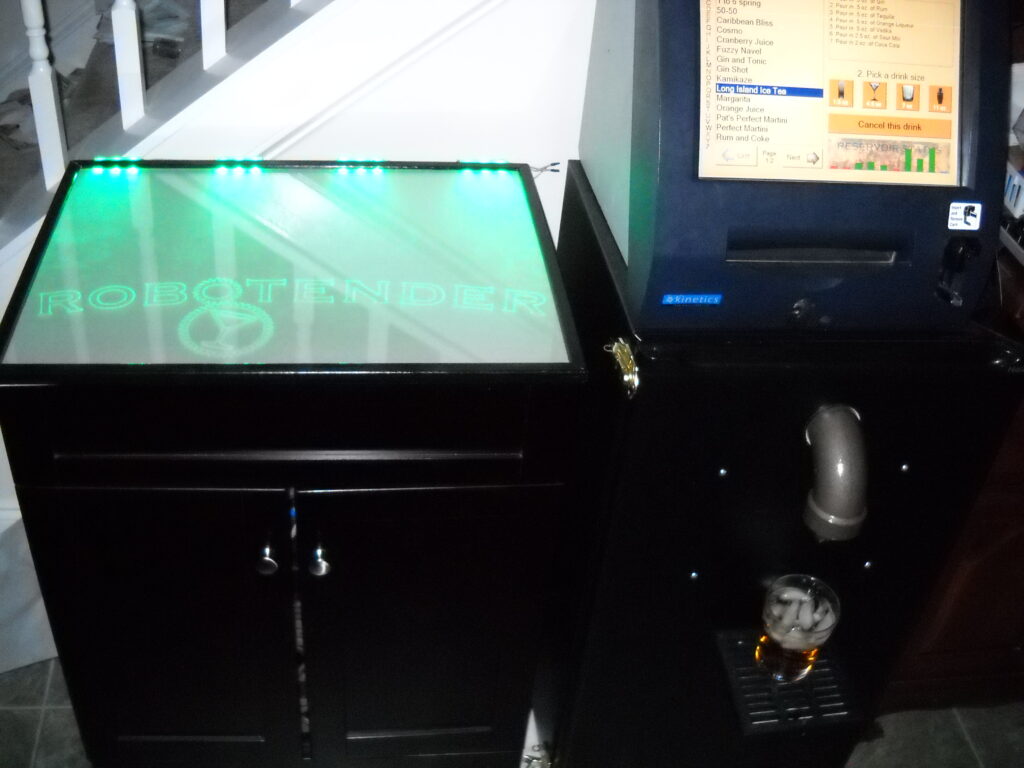
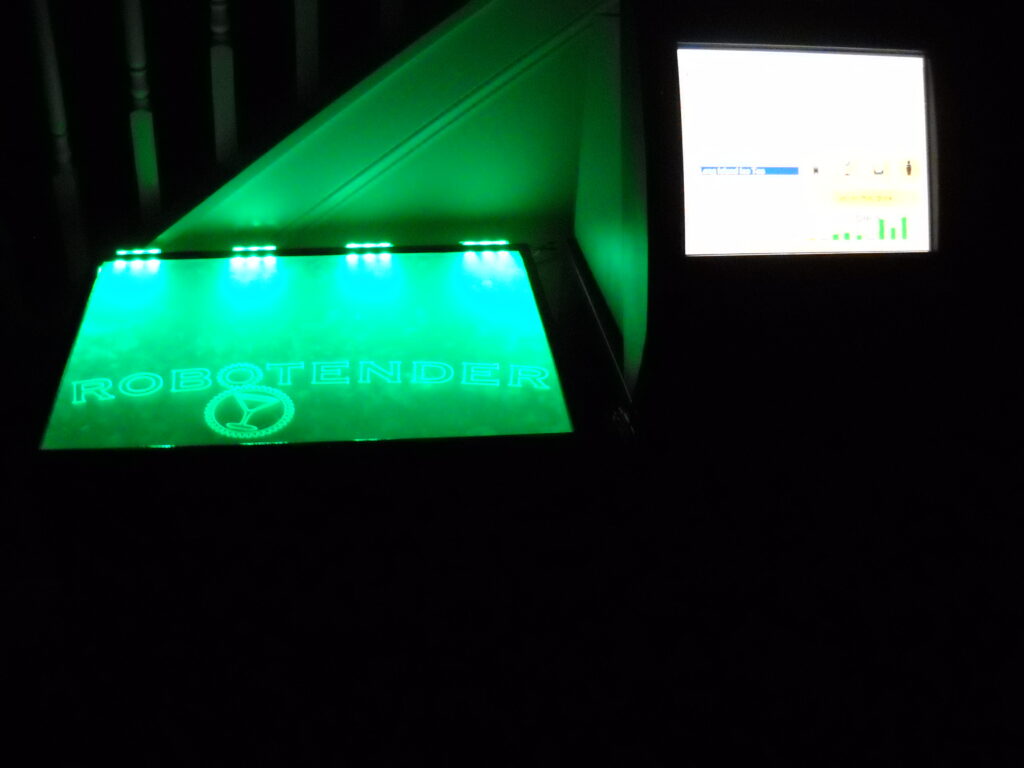
Robotender is a robotic bartender. It can mix any quantity of 9 different liquids together to make a wide range of drinks. The touch screen allows a recipe and drink size to be selected and it will then be poured. If a recipe contains any ingredients that aren’t currently loaded into a reservoir, the screen will instruct you to pour that one in manually. One of the most enjoyable drinks to pour is a Long Island Ice Tea, which causes 5 reservoirs to activate in quick succession, and only needs to be topped off with a touch of Cola for color.

The system works with a set of pressurized reservoirs and electronically controlled solenoid valves.  When a valve is activated, the pressure forces the liquid out and into the glass.

Conceived of many years ago and built in the fall of 2008.

Full system test (Dec 4th)