Sunny Day

Sunny Day is a game that I worked on at the 3rd Triangle Game Jam with Mike Daly, Rett Crocker, and Brett Brown.

The theme for this jam was Music Video Games, to come up with a game idea based on or inspired by a song (note: not creating rhythm games).

A little girl goes for a walk. When the sun shines on her, she is happy and spreads happiness to all those around her. When she is in the shade, she is sad. You control the sun, who wants to make the girl as happy as you can. You do so by positioning the sun so that the clouds beneath you don’t end up shadowing the girl.

The concept from this game was based off of the song “Sunny Day” from the Vib Ribbon soundtrack by the Japanese music group “Laugh & Peace”.

Check out the Triangle Game Jam page for Sunny Day for a download and more information. We struck a compromise between the two day approach of previous triangle jams and the 2.5 day approach (meet and start working Friday night) in the Global Game Jam by meeting on Friday night to come up with ideas and teams over BBQ and beer, but we didn’t start coding until we met on Saturday morning.

Space Fish

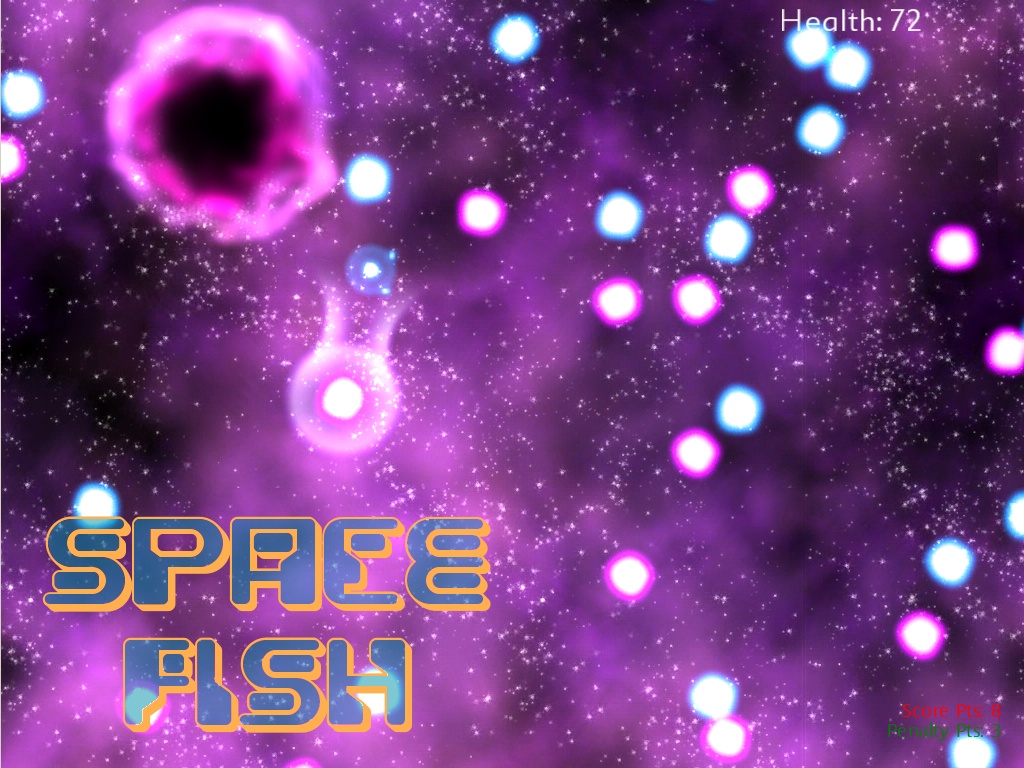
Space Fish is a game that I worked on during the first Global Game Jam at the Raleigh-Durham site with Nick Darnell. The theme was ‘As long as we’re together, we’ll never run out of problems’.

It’s sort of a physics-sandbox game, where you can use your StarBeam to grab red or blue stars and fling them around.

Mindy the Space Fish is a persistent omnivore which will exist until the end of time. You are Mindy’s minder, feeding her pesky Red stars and keeping her from eating the pretty Blue stars.

As Mindy’s minder, you are free to ignore her. However, if you want to stick around with Mindy, your life will be full of problems.

The text we included with the game:

This is Mindy the Space Fish.
Mindy likes to eat things.
You are Mindy’s minder.

Care and feeding of the Space Fish:

  • In particular, there are Red stars and Blue stars floating about that Mindy wants to eat.
  • Red stars are painful to you, so you should throw them all to Mindy.
  • You’ve got nothing against Blue stars and would be very sad if Mindy ate them all.
  • You and Mindy would both be sad if Mindy ate you, but Mindy cannot help herself.

You’ve got a StarBeam that you can use to grab the nearest star and you can fling it about, either towards Mindy or away into space. We ran out of time to create a real level, so the scene is really crowded and it ended up being more of a physics sandbox than a puzzle, but with a bit more time and actual level design, it would probably be pretty fun.

There is more information, source code, and precompiled binaries available at the global game jam page for Space Fish.

Additional Credits: Patrick Sebring created the title screen, Harrison Moore made the music, and Mike Daly saved us from programmer art by making some sprites in Max and exporting them to spritesheets.

Pixelated Martini Roller

Pixelated Martini Roller is a game that I worked on during the second Triangle Game Jam with Nolan Walker and Vincent Scheib.  Brad Acree did the awesome title screen artwork and the music is by STU.

You play an angry drunken olive off to discover the meaning of live, or something…

The theme for the game jam was mad libs.  Everyone brought three lists of five words and we randomly generated game titles at the start of the jam, then we came up with and pitched ideas to go with the best names until we’d coalesced into teams.  I highly recommend this mechanism to anyone thinking about hosting a game jam.

The game plays like time attack mode in a classic 2D platformer: you run through the level and need to hit each of the checkpoints along the way to finish.  However, you won’t make it very far sober, the olive has to soak in alcohol in order to make some of the jumps.  As the olive gets intoxicated, you can jump higher and run faster, but the superpowers come with some downsides: the screen becomes pixelated and the music distorted as the drunk-o-meter fills up.  If the olive gets wasted, you actually lose control and cannot accurately jump or run until it sobers up.

I built the level editor (it’s built right into the game and you can toggle back and forth during gameplay), the checkpoints, the drunk-o-meter, and game flow logic (title screen, gameplay, editor, win screen, etc…).

T27 Puzzle Game

A simple puzzle game with retro graphics

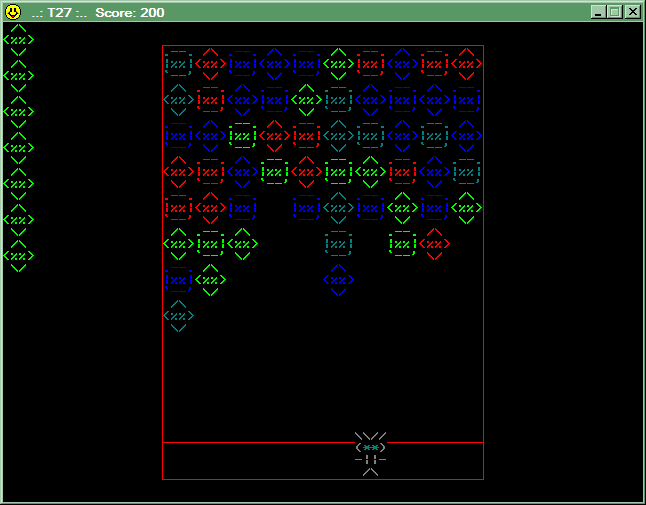
I don’t remember why I titled it T27, although it might have taken 27 minutes to make the very first version. All in all, I spent about a day playing around with the concept and here you have it. The main idea was to do something fun and fast with ASCII graphics so I didn’t get bogged down making it pretty.

T27 Gameplay

You play an owlish character (it’s hard to portray fine details in a 4×4 ASCII grid) who must defend himself from evil invading cubes. Your owl has the ability to grab cubes from the sky or throw them back, although he can only carry cubes of one color at a time.

These cubes come in a variety of colors and ones of the same color don’t get along well. If three or more cubes of the same color come into contact, they get into an argument and explode. Use this to your advantage and save the world!

After a number of grabs or throws, the screen will start to vibrate, indicating that another wave is approaching. Your owl can do two more things before the next wave comes, but he is fighting a losing battle, as the cubes never stop coming.

aMaze – A game for visually-impaired children

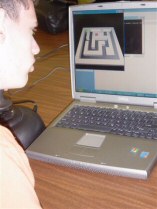
I took the Enabling Technology class and worked in a group on the aMaze project, which provided a maze game to children with visual-impairments.  A 2D maze is simulated, and the child can walk around inside the maze using a keyboard, joystick, or Sensable haptic-feedback device.  Footsteps, simulated cane taps, and environmental sound sources are modelled in 3D, allowing the child to navigate by sound.  There is also a visual display of the maze and current position, which can be used for debugging or disabled if a child has partial vision and wishes to try it by audio alone.

The EVE group at UNC has a bunch of foam cubes that they use to construct interesting virtual environments, and we thought of asking a few children to come in and try walking a real maze and the virtual maze.  Some children would do the virtual maze first, and others would do the real maze first, and we could find out if they felt more prepared for the real maze after doing the virtual one.

The experience ended up snowballing (with the help of many) into a Maze Day with 51 visually impaired students and 55 adults visiting the UNC Computer Science department to view all of the class projects and previous research, instead of just aMaze.  Maze Day has since become an annual event, and will be held again towards the end of April.

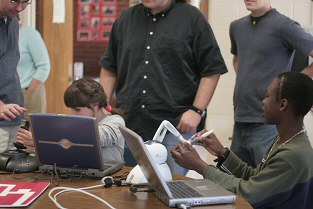
Pictures from preliminary testing

Our aMaze team had a station with 3 computers, one with a keyboard, one with the joystick, and one with the Sensable Phantom.  We also made a real maze (complete with wolf and elephant sound sources played back at the bends of the maze) constructed in a room that matched one of the virtual mazes that were being shown.  By navigating the maze using the computer beforehand, the general consensus was that it was much easier to navigate the real maze.  Maze Day was a lot of fun, and we were proud to be a part of it.

Capstone project (Arcade Game System)

All CS students at the University of Missouri – Columbia are required to do a capstone project in their senior year.  My group decided to make a game console for an arcade cabinet and a game to demonstrate it.

The capstone project is broken into two semesters, with the first semester spent on the design process and various state educational requirements they couldn’t fit into any other class like IP law and ethics.  The class doesn’t meet during the second semester, with the time instead allocated to group meetings.

Our team (EONGames / Arkanerdz) consisted of:

  • Adam Crume
  • Dustin Culbertson
  • Michael Noland
  • Remy Nsengiyumva
  • Tim Vette

The console was based around a BlueStreak ARM SOC running at 77 MHz, with a 512×384 framebuffer (visible display region is smaller), and plugged into any standard arcade cabinet with a JAMMA connector.

The game we made for our system was ‘Super Magical Happy Fun Kill Time II’, which is a Leprechaun themed 2D shmup written in C.

I have placed the project presentation from semester 1 online, but the prototype hardware ate itself after the semester 2 final presentation when someone plugged the JAMMA connector in backwards.  The polarity key in the JAMMA connector of my old cabinet fell out at some point, and no-one noticed, but thankfully it happened after we had presented for the class!  When I get around to it, I was thinking about making an emulator for it to show off the game, or just buying a new SOC board.

VR Pong

VR Pong was developed for Engineering Week 2003 at the University of Missouri – Columbia . Every year, about one thousand students of all ages (K-12) come to look at exhibits at the Engineering department during E-Week.

A stylish shot of my arm playing

We had just set up the Computer-Human Interaction Laboratory and needed to put some exhibits together that could be enjoyed by most students, so I decided to do something with some Polhemus position sensors. It ended up being a big hit, and we had problems keeping the students moving through because everyone wanted a chance to play.

VR Pong is designed to be played by two people at once, one person with their right hand, and another with their left hand. Each player looks at their own computer monitor and sees a view from one end of a rectangular corridor. The position of their hand determines where the paddle on the screen is positioned, and each player attempts to score against the other by knocking the ball past their paddle. The game doesn’t use the touch sensors embedded in the gloves, they were used because it was convenient.

Magnetic tracker and gloves

Cactus Jack: The Adventures of the Deranged Space Monkeys

A 3-D shooting game where you will have to work hard to figure out how all of the objects can be tied together! The camera hovers above and behind the player, allowing you to have the best control over him as you blast away at chocolate bunnies and surplus space telescopes.

Cactus Jack was my final project for CECS 361 (now CS4610) Computer Graphics I, along with Mike Reall and Mike Sullivan.

The gameplay is constrained to 2D and is a bit like asteroids, but the graphics are 3D.

Absolute Terror

Absolute Terror is a 3D PC game published by Crystal Interactive in 2001 and developed by SymbioSys Software (now Neko Technologies).

From the manual (i.e. from Ben’s twisted sense of humor):

In Absolute Terror, you venture into space, the last best hope for Earth in their war against rebelling colonies on distant worlds.  Or maybe they’re aliens; hideous space-monsters who threaten all mankind. No, no, actually, they’re definitely rebelling colonies – not that it really matters.  What really matters, of course, is that you get a state-of-the-art spacecraft (with big guns), a sarcastic co-pilot (with big… uhhh, nevermind!) and a license to blow things up in a spectacular and over-the-top fashion!

I wrote the scripting engine and many of the special effects used in the game while working for SymbioSys.